Thursday, 2 December 2010

The Quiet - Pass


The Quiet
(2005, USA) is a drama with thriller elements by Jamie Babbit, the woman who directed the wonderful comedy/satire drama "But I'm A Cheerleader" about a girl sent to a therapy camp to cure her lesbianism she herself didn't even know she had before.

The Quiet is not that easy to detect as standart-questioning movie. However, just one look at the poster reveals that yes, it passes the test easily. Despite the main character, Dot (Camilla Belle), not speaking most of the time.
Dot who everyone beliefs to be deaf and dumb goes to live with her godparents and their daughter Nina after her father dies. The atmosphere gets stranger and weirder - helped by the camera and lighting - as she discovers that Nina and her father share an incestuous sexual relationship that Nina herself is torn about, stating that she loves her father but hates him, too, planning to kill him. At the same time Dot and a popular guy at her High School fall in love, making her feel bad about pretending to not be able to speak or understand him.

"Many reviewers complained that it was sleazy, exploitative, and difficult to watch, and that it was too serious to be satire, yet too camp to be taken seriously" - This is very much why I had problems with this movie. While it is in no way a bad movie, it seems to be unsure about what it wants to be. It is entertaining and intriguing but also just plain weird, in a good as well as in a bad sense.

Elisha Cuthbert (before this role rather known for her parts as the plain blonde in "The Girl Next Door" or, even more tellingly, along-side Paris Hilton in the Horror remake of "House of Wax") plays the part of very messed up Nina in a way that changes between pitiful crazy abused daughter, hateful arrogant and calculative High School bitch and "appealing slut" for anyone looking out for incest porn, while Camilla Belle makes Dot seems very cold and more sure about everything she does then it would make sense in regards to her actions.

All the other actors seem very convincing, especially Martin Donovan as Paul, Nina's father, who - despite not having that many lines in this movie - gets the trouble inside his head between wanting to be a good person and his illness across well. However, exactly this, him coming across like a wholesome person with feelings who needs help, while his daughter at times seems like the one in charge in their sexual relationship, makes you wonder what exactly the director is trying to say here, if anything.
Edie Falco as the mother of Nina and wife of Paul, does a great job at portraying the mother who tries with all her might not to see what is going on, just to keep up the picture of a working family. Despite all this I couldn't help but think "But she's Carmela Soprano! Where is Tony!?" at times...

Also, there is this Beethoven theme throughout the whole film that seems somehow tragically random and misplaced.

The Quiet is definitely not your usual High School drama/family movie/thriller, but that doesn't make it automatically good. There's a lot of potential in almost every role and every direction the film is trying to take, but no consensus means it ends up in a very mushy emotional mess. If anything - it does entertain.


Verdict: Pass & Undecided

Sunday, 28 November 2010

What is this Blog? What is the Bechdel Test?

A few weeks ago I was watching a DVD with my boyfriend. While I enjoyed Jim Jarmusch's 1995 "Dead Man" I couldn't help but notice the lack of women appearing. There were two in total, both lovers without any significance for the story or any real characterisation. My boyfriend asked whether that made the film any less of a good one. In my opinion, it doesn't necessarily. I still found it important to point out that it bothered me somehow and that while I could enjoy the movie for its' artistical value and have no trouble finding ways of identifying with males, I just wondered how many good movies were out there that actually did feature women with actual interesting characters.
The thought that even in Art and Independent movies the patriachial pressure still leaves filmmakers subconsciously (I hope!) make the decision to give a very unequal portrayal of female and male characters, saddens me very much.

On the wonderful livejournal community wtf_sexism I read someone talking about the Bechdel test for movies. What is it?
The Bechdel Test, Bechdel-Wallace Test, or the Mo Movie Measure is a sort of litmus test for female presence in movies and TV. The test is named for Alison Bechdel, creator of the comic strip "Dykes To Watch Out For" out of which the test emerged. In order to pass, the film or show must meet the following criteria:

  1. it includes at least two women
  2. who have at least one conversation
  3. about something other than a man or men.

I'll let others explain it better than I would:

"The test is often misunderstood. The requirements are just what they say they are - it doesn't make any difference if, for instance, the male characters the women talk about are their fathers, sons, platonic friends or mortal enemies rather than romantic partners. Conversely, if a work seems to pass, it doesn't matter if male characters are present when the female characters talk, nor does it matter if the women only talk about stereotypically girly topics like shoe shopping - or even relationships, as long as it's not relationships with men.

This is because the Bechdel Test is not meant to give a scorecard of a work's overall level of feminism. It is entirely possible for a film to pass without having overt feminist themes (...). A movie can easily pass the Bechdel Test and still be incredibly misogynistic. Conversely, it's also possible for a story to fail the test and still be strongly feminist in other ways, and there's nothing necessarily wrong with that. What's a problem is that it becomes a pattern - when so many movies fail the test, while very few show male characters whose lives revolve around women, that says uncomfortable things about the way Hollywood handles gender." (source)


I stumbled over a link to a blog that did exactly this, setting movies (and other pieces of culture like books) to the Bechdel test. Sadly it was short-lived and only active from January to March 2009. I googled around and found This Website that lets anyone add movies to their index. There are quite a few films listes but sadly not many reviews.
This and my new-found overenthusiasm for films inspired me to start this blog.

I won't promise long reviews because I'm sure that would lead to a sudden downfall of this blog. What I will do however is set every movie I watch to the test.

To clarify: I will still recommend movies that don't pass the test if I find myself enjoying them, as well as I will tell you if I thought a movie sucked despite passing the test.
While giving a general idea about just how misogynist the film industry still works, I also hope the blog will be some guide to finding new movies to enjoy. I don't believe the lack of women should actually make you avoid a movie, just like I don't believe you shouldn't read Nietzsche just because you don't share his views on gender questions (in the same way I would still read old greek philosopher's for their inspiring thoughts despite strongly disagreeing with their racist and pro-slavery stand points) - I just believe talking about the problem and pointing it out wherever you see its implications in the first step to a change for anything.


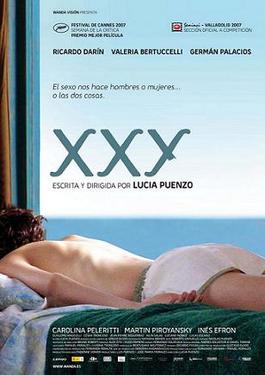
XXY - Pass


XXY (2007) by LucÍa Puenzo tells the story of Alex (Inés Efron plays wonderfully convincing here!) a 15-year-old intersex person who is being raised as a girl with the help of medicine to surpress masculine features. The film deals with the way the family copes with her/his condition, first love and the ultimate decision that s/he must eventually take in a gender-driven world.

Recently Alex has stopped taking her meds. Her mother invites friends to stay with them for some time: a surgeon, his wife and teenage son Álvaro. Her hope, unknown to her husband and Alex, is to discuss the possibilities of a sex-change operation and turn Alex finally into the "proper" girl she has always wished to have. Alex' father, a biologist, however is unsure about it and just wants what is best for his child.

Meanwhile Alex and Álvaro start a strange and mutually confusing relationship that causes turmoil in both their sexual and emotional identities.


This Argentine film is very strong on emotional and visual levels alike, and comes with a clear and loud message: not to press gender identity on children and making them insecure about their bodies and feelings.

Verdict: Pass & Highly Recommended